IPv4 addresses are shorter
In an article over on LinkedIn (German) I read that IPv4 is more popular than IPv6, because the addresses are shorter.
Well, most IPv4 addresses are shorter, but when you compare 127.0.0.1 and ::1 IPv6 clearly wins. Case closed. Have a nice day!
Well not so fast. Why are people not using IPv6?
I’ll take this opportunity to invite you to something I’ve been thinking about and announced and promised to start some time ago: A series of blog posts and YouTube Videos where you can learn about IPv6 and related topics. This is the first article to the first video!
Reason 1: It’s different#
As mentioned in a previous article IPv6 is different. And it’s different in many ways. Yes, most addresses are longer. They are written in hexadecimal, and use “:” instead of “.” as separators. And you have to use prefix notation instead of masks.
In IPv4 you can, depending on the implementation, choose between 192.0.2.0/24 and 192.0.2.0 255.255.255.0 in IPv6, you only have the prefix notation, e.g. 2001:db8::/48.
When doing workshops or presentations there are almost always people not familiar with the prefix notation.
But there are other differences:
- ARP was replaced by neighbor discovery, which uses ICMPv6
- There is autoconfiguration, also using ICMPv6
- There are mechanisms to generate random IPv6 local parts of addresses
- DHCPv6 is different from DHCP(v4)
- You should start thinking in terms of network prefixes and not single addresses
And because of these difference people have to learn new things. And that takes time. Time that people don’t have. Or at least say they don’t have.
Reason 2: People hear that IPv6 is very important for ages#
The two most compelling problems facing the IP Internet are IP address depletion and scaling in routing. Long-term and short-term solutions to these problems are being developed. The short-term solution is CIDR (Classless InterDomain Routing). The long-term solutions consist of various proposals for new internet protocols with larger addresses.
The above quote is from RFC1631 published in May 1994, titled “The IP Network Address Translator (NAT)”.
It was noticed early on that we don’t have enough IPv4 addresses and need better ways do deal with the limited resources we had in the short term, but that a protocol woud be needed in the long term.
One of these short term solutions was NAT, as described in the RFC. Also, from the RFC:
NAT has several negative characteristics that make it inappropriate as a long term solution, and may make it inappropriate even as a short term solution. Only implementation and experimentation will determine its appropriateness.
But guess what: NAT is a huge success. Yes it broke, and still breaks, stuff, but we found workarounds or gotten used to these problems. There are quite a few people who believe that networks without NAT can’t work, probably because they have never had contact to a network without it. And how could I write about NAT without linking to this video. And we have new versions of NAT, e.g. translating from IPv4 to IPv6.
Over the years, we were told that we will eventually run out of IPv4 addresses. And we did. IANA handed out the last /8 networks to the five local internet registries (LIR) in February 2011.
The LIRs then defined their on polices on handing out addresses from the last /8. In the RIPE region you were only getting one /22, and they created a waiting list after the last /8 ran out. When you now become a new RIPE member, you can add yourself to the waiting list and maybe get a /24 when prefixes are returned to RIPE.
But there is a market for IPv4, people are selling and buying IPv4 addresses and while the price for an address was above $50 for some time, we are way down now. While researching for this post I saw $17.80 per address for a /14. There are a lot of brokers for buying and selling IPv4 addresses, just use your favorite search engine to find one if you want to sell or buy IP addresses.
One of them is IPv4.Global and I link and name them here because they are the only broker I know, that publishes their offering openly and publish their previous sale prices. This article is not sponsored, but I won’t mind some sponsoring retroactively. ;-) Today they list prices between $17.80 and $26 per address. This can add up, but prices were more then double not long ago.
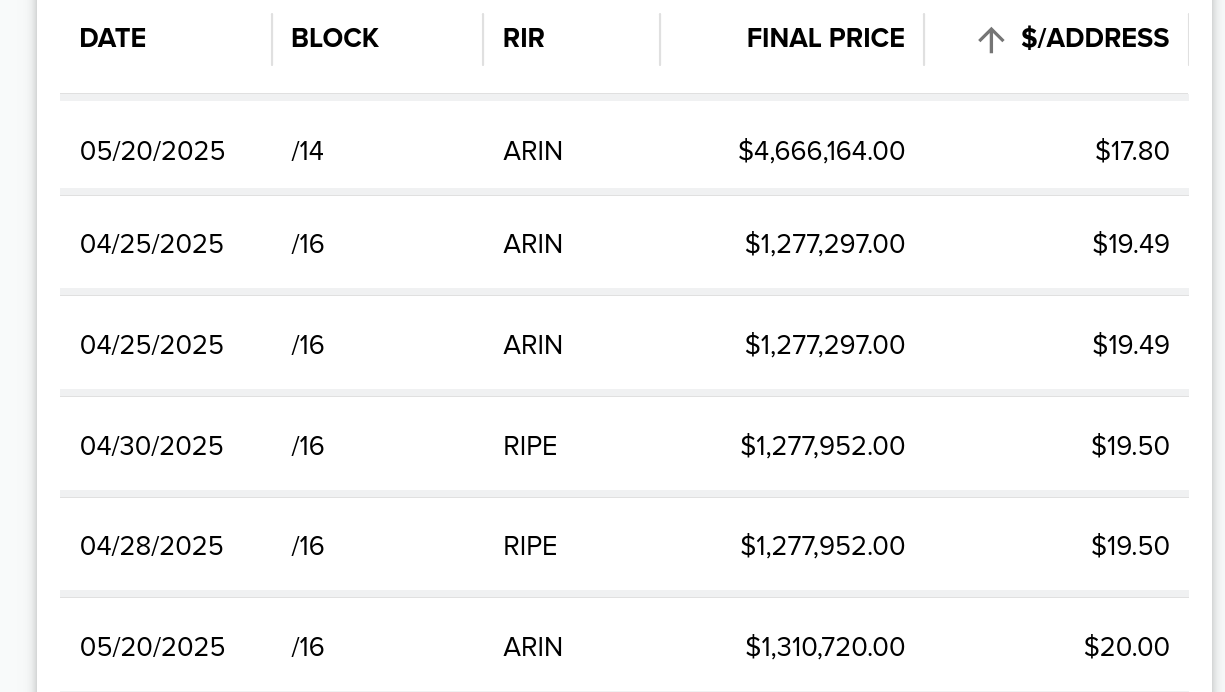
And there are also companies that charge extra for public IPv4 addresses, e.g. AWS who are charging $0.005 per hour for a public IPv4 address that is in use. This can add up.
Reason 3: “We do have enough IPv4 addresses”#
Well that may be true for you, but certainly not for everyone out on the Internet. And it’s called Internet for a reason. It’s a network of networks. There are also organisations that simply ran out of IPv4. Private and public.
Or think of two companies merging. Both using addresses from 10.0.0.0/8 from RFC1918 and both used overlapping addresses at beginning of that prefix. Or you want to set up VPNs to customers or suppliers. All using the same addresses from RFC1918. Or you offer IT services and customers source out their IT to you. Probably all your customers will have the same RFC1918 addresses. You’ll end up using multiple layers of NAT and that is not fun to implement, document and debug.
But: IPv6 is here#
Depending on where in the world you are, you may already be using IPv6. The following picture shows the IPv6 adoption as Google sees it for Europe. Dark greens mean more IPv6 adoption.
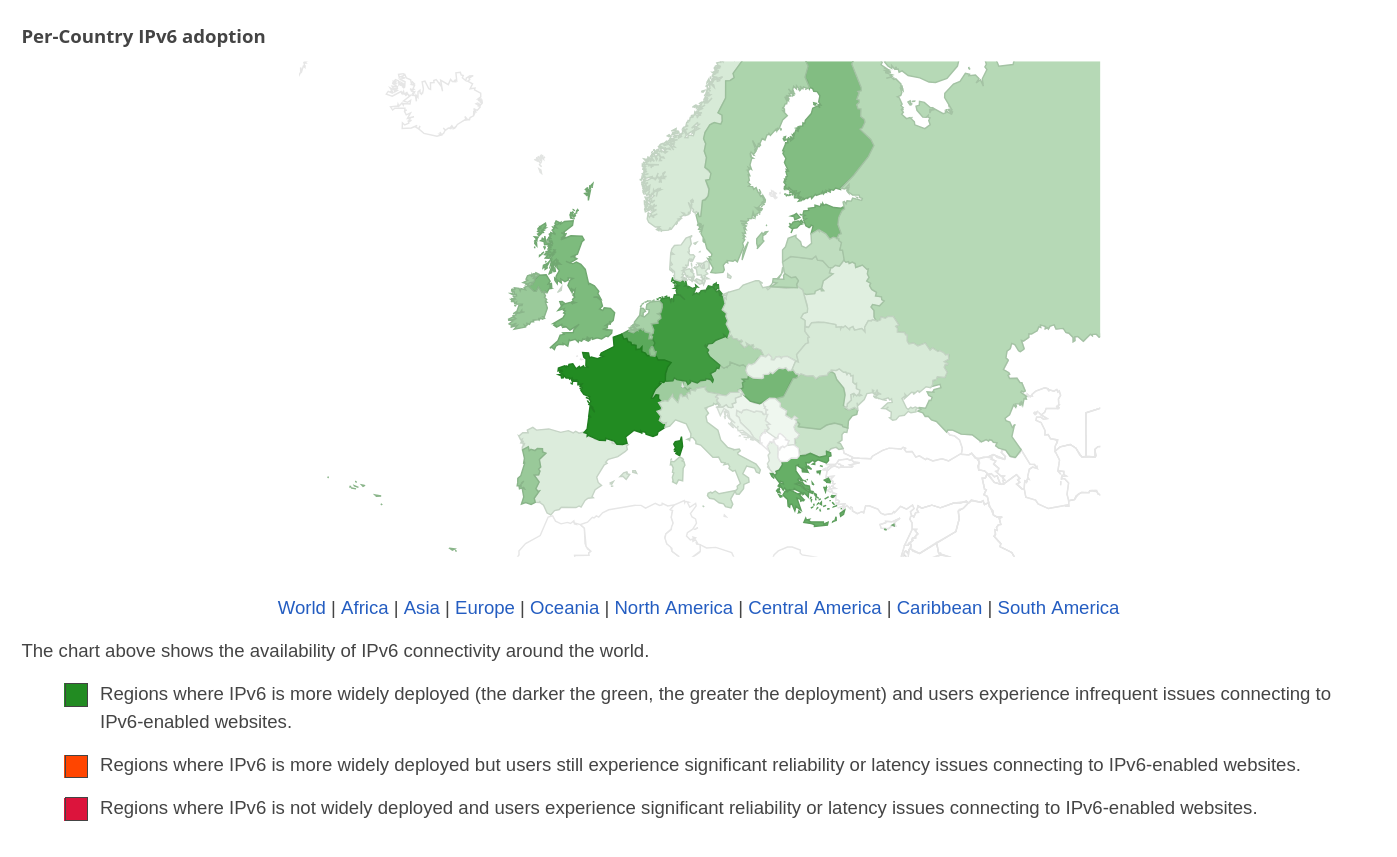
There are several of these statistics out there, there is a list here along with several other IPv6 related resources. Additions and bug fixes are welcome.
When you visit the Google IPv6 statistics page you can hover over your country and see some more information. Today google sees almost 74% IPv6 traffic in Germany, and it is also having just a bit less latency.
In all the (darker) green countries the providers hand out IPv6 addresses. Some may even give you a public IPv4 address. In many cases they’ll hide IPv4 behind some form of NAT. This works most of the time, but it may break things. Some years ago I talked to the head of the network department of a large insurance company:
“I don’t care where we start with IPv6, but remote VPN access is first.”
That was their biggest problem: Remote users behind some form of NAT for IPv4 not being able to establish VPN connections to do their jobs.
Reason 4: Costs#
Yes IPv6 costs. At least your time learning it and implementing it. And depending on where you implement IPv6 also the time of your coworkers. And there maybe other costs involved, like training, new hardware, changes to existing software.
You should have up-to-date documentation, which includes all the hard- and software you are using. And yes nobody likes writing documentation. But on the other hand having good documentation makes life easier and maybe frees up some of your time.
Reason 5: Security#
Yes IPv6 has some security risks. And I don’t mean in products you buy for your network. Even in 2025 there are enough IPv4 only security problems in products you buy. But you and your coworkers are unfamiliar and may overlook something. But would you rather start slowly now, or be forced to do everything at once when you really have to do IPv6 because your provider does not IPv4 anymore or that shiny new toy your CEO or board members want only supports IPv6?
And there are some security risks in just ignoring IPv6. Most vendors don’t recommend turning off IPv6 because that may break stuff. And indeed it sometimes does. Back in the day I heard from two people that they, or one of their customer, disabled IPv6 on a Microsoft Small Business server. One was lucky and had a backup. The other one got it somehow working after a couple of days trial-and-error.
And yes that is a thing. Years ago a friend worked for a company that had a very strict policy against Wireless LAN. The CEO didn’t want it for security reasons. Until he got a new MacBook. One without a wired connection. It only took 5 minutes and one apprentice was on the way to the electronics store around the corner to buy an access-point.
But …#
IPv6 is an opportunity. You may get more reliable VPN connection (see Reason 3) and thus happier users. And less support calls. You need to update your documentation which helps troubleshooting issues faster. You can also rethink and renew your monitoring while implementing IPv6. There is a good chance that you can clean up and simplify your infrastructure, which again leads to less troubleshooting and more time for you. Cleaning up also means that you may remove some now unneeded hardware which reduces your power consumption.
And knowing how to work with IPv6 also increases your market value. Having IPv6 know-how in your CV is not a bad thing to have in your CV.
Conclusion#
I know. Lots of text. Good that you made it to then end. If you are interested to learn more about IPv6 subscribe to the YouTube channel, this blog, and follow me on mastodon.